
Biology
Biology A Level explores the science of life - from cells and molecules to ecosystems and human health. You’ll investigate how living organisms function, interact and adapt, while building strong practical, analytical and problem‑solving skills.
If you’re curious about the natural world, enjoy scientific investigation and are considering careers in medicine, psychology, environmental science or research, Biology is an excellent choice. At St Brendan’s, we teach Biology in a clear, supportive way, helping you grow in confidence as your understanding develops.
- Qualification
- A Level
- Exam Board
- OCR
- Duration
- 2 years
Why study Biology at St Brendan’s?
Biology is a demanding but highly rewarding subject that opens doors to a wide range of university courses and careers. You’ll develop a deep understanding of key biological concepts while learning how scientists design experiments, analyse data and evaluate evidence.
At St Brendan’s, our specialist Biology teachers support you every step of the way. Lessons are well‑structured, practical work is carefully guided, and you’ll receive regular feedback to help you build exam confidence and scientific independence.
Entry requirements
- Two Science GCSEs at grade 6 (including Biology if taken separately)
- Or GCSE Combined Science grade 6‑6 or above
- GCSE Maths grade 6 or above (Grade 5 considered)
- GCSE English Language grade 4 or above
- At least five GCSEs at grade 4 or above

Course examination breakdown
What else do I need to know?
Seperate Sciences GCSE Biology grade 6 or above plus Chemistry or Physics grade 6
Or GCSE Combined Science grade 6‑6 or above
GCSE Maths grade 6 or above (Grade 5 considered)
GCSE English Language grade 4 or above
At least five GCSEs at grade 4 or above
Year 1
- Cell structure
- Biological molecules
- Nucleic acids
- Enzymes
- Biological membranes
- Cell division, cell diversity and cellular organisation
- Exchange surfaces
- Transport in animals and plants
- Diseases and the immune system
- Biodiversity
- Classification and evolution
Year 2
- Homeostasis
- Excretion
- Neuronal communication
- Plant and animal responses
- Photosynthesis
- Respiration
- Cellular control
- Patterns of inheritance
- Manipulating genomes
- Cloning and biotechnology
- Ecosystems
- Populations and sustainability
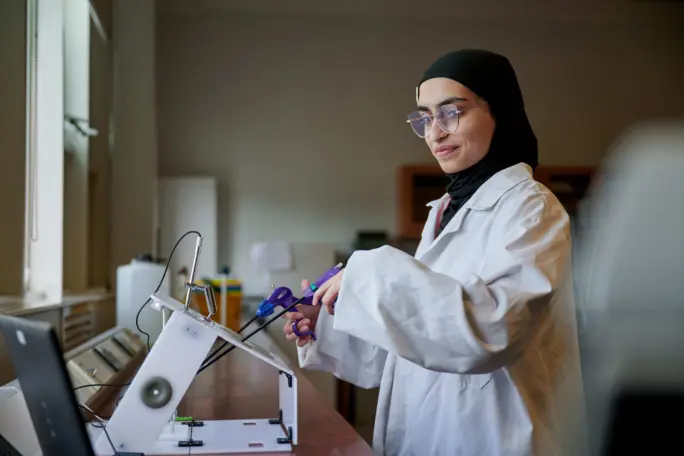
Lessons combine clear explanations, practical experiments, group discussion, exam practice and independent study. You’ll regularly apply your knowledge through required practical activities, helping you connect theory with real scientific investigation
Students studying A level Biology will be expected to take a very active role in their learning. Before each lesson students will prepare for their learning by watching videos and reading through relevant sections of our online textbook to familiarise themselves with the topic and make notes. This means that there is more time in lessons for students to practise skills, investigate topics further, consolidate learning and complete practical investigations.
Additional support can also be offered to those students who are not studying Maths and/or Chemistry along with Biology.
Methods of Assessment
A-level Biology is entirely assessed by written examination at the end of the 2-year course; a total of six hours of assessment split over three examination papers. Students will also complete a range of practical activities; and the knowledge and understanding will also be assessed within the written exams.
Laboratory skills will be assessed by teacher observation in class for the Practical Endorsement.
Biology has modern, well-equipped laboratories serviced by a team of Science Technicians.
We use a range of online learning resources including an online textbook, the learning platform Seneca and curated video clips.
Trips may incur a small cost for transport.
Students need to buy a CGP revision guide and workbook at the start of the course to help with preparing for lessons, regularly reviewing learning as well as revision for Key Assessments in class.
Biology cannot be taken alongside Human Biology.
Biology works particularly well with:
- Chemistry
- Physics
- Maths
We’ll support you in choosing subject combinations that best suit your strengths and future goals.
Biology A Level supports progression into:
- Medicine, Dentistry and Veterinary Science
- Biological Sciences, , Biomedical Science
- Environmental Science and Ecology
- Healthcare, research and laboratory careers
- Higher and degree apprenticeships in science and health sectors
Students can also join the BioMed group; which aims to inspire, encourage and support students aspiring to study Medicine, Veterinary Science, Dentistry, Nursing, Midwifery or Biomedical sciences. This group can help students to gain work experience and prepare for the competitive application processes. Extra-curricular events have included masterclasses delivered by scientists, skills workshops, practice interviews and personal statement workshops. You may have opportunities to take part in:
- Science talks and workshops
- STEM enrichment activities
- University preparation and UCAS support
Former Biology students from St Brendan’s progress to a wide range of university courses and career pathways. These include degrees in Biological Sciences, Medicine, Psychology, Biomedical Science and Environmental Science, as well as science‑related apprenticeships and healthcare routes.
Many students go on to study at Russell Group and other leading universities, using the strong academic skills and practical experience developed during their Biology A Level.

Progression opportunities
Related courses
Physics
A LevelA Level Physics develops your understanding of the principles governing matter, energy, space and time, from sub-atomic particles to the uni…
Chemistry
A LevelChemistry A Level explores the substances that make up our world and the reactions that transform them. From atomic structure to organic com…
Human Biology
AAQAAQ Human Biology offers a practical, real‑world approach to studying biology, with a focus on human health and the diagnosis and treatment …