
Chemistry
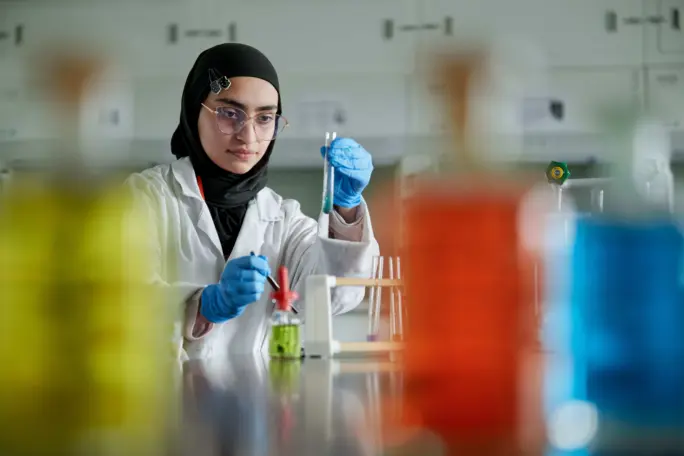
Chemistry A Level explores the substances that make up our world and the reactions that transform them. From atomic structure to organic compounds, you’ll develop a deep understanding of how chemistry explains everyday materials, medicines and technologies.
If you enjoy problem solving, practical work and understanding how things work at a molecular level, Chemistry is a strong choice. At St Brendan’s, we teach Chemistry in a supportive and structured way, helping you build confidence as the subject becomes more challenging.
- Qualification
- A Level
- Exam Board
- AQA
- Duration
- 2 years
Why study Chemistry at St Brendan’s?
Chemistry is a respected and challenging subject that keeps your options open for a wide range of university courses and careers. You’ll develop strong analytical skills while learning how chemical principles are applied in real‑world contexts, from healthcare to engineering and environmental science.
At St Brendan’s, our experienced Chemistry teachers explain complex ideas clearly and support you through each stage of the course. You’ll get regular feedback, guided practical sessions and structured exam preparation to help you succeed. Chemistry students who are not studying A Level Mathematics are strongly recommended to study maths beyond GCSE level to support the development of mathematical skills required for this course for example studying Core Maths.
Entry requirements
- Two GCSEs in Science at grade 6 (including Chemistry if taken separately) or Combined Science grade 6‑6
- GCSE Maths grade 6
- GCSE English Language grade 4 or above
- At least five GCSEs at grade 4 or above

Course examination breakdown
What else do I need to know?
Two GCSEs in Science at grade 6 (including Chemistry if taken separately) or Combined Science grade 6‑6
GCSE Maths grade 6
GCSE English Language grade 4 or above
At least five GCSEs at grade 4 or above
The A-level course is divided into three areas with year 2 topics building on those taught in year 1.
Physical chemistry:
Year 1
Atomic structure, Amount of substance, Bonding, Energetics, Kinetics, Chemical equilibria, Le Chatelier’s principle and Kc, Oxidation, reduction and redox equations.
Year 2
Thermodynamics, Rate equations, Equilibrium constant Kp for homogeneous systems, Electrode potentials and electrochemical cells, Acids and Bases
Inorganic Chemistry
Year 1
Periodicity, Group 2 the alkaline earth metals, Group 7 (17) the halogens
Year 2
Properties of Period 3 elements and their oxides
Transition of metals
Reactions of ions in aqueous solution
Organic chemistry
Year 1
Introduction to organic chemistry, Alkanes, Halogenoalkanes, Alkenes, Alcohols, Organic analysis
Year 2
Optical isomerism, Aldehydes and ketones, Carboxylic acids and derivatives, Aromatic chemistry, Amines, Polymers, Amino acids, proteins and DNA, Organic Synthesis, Nuclear magnetic resonance spectroscopy, Chromatography
The course is tutored by well-qualified Chemistry specialists who aim to stimulate interest in and enjoyment of Chemistry and to foster imaginative, logical and critical thinking.
You'll regularly apply your knowledge through practical experiments and investigations, helping you understand the relationship between theory and real-world chemistry.
The course is tutored by well-qualified Chemistry specialists who aim to stimulate interest in and enjoyment of Chemistry and to foster imaginative, logical and critical thinking. The course integrates theory and experimental work, developing analytical and manipulative skills. Students are encouraged to develop scientific communication skills through research, discussion and written work. Alongside the exam grade, student certificates will also show if they have achieved the Practical Endorsement. This is a pass/fail mark generated from their practical skills and portfolio of practical work.
Methods of Assessment
Students will sit three written exam papers at the end of the course each lasting 2 hours. During the course students will complete a range of practical activities. Some skills will be assessed by teacher observation in class and teacher marked practical reports. The remaining skills will be assessed within the written exams.
- Modern, fully equipped chemistry laboratories
- Specialist Chemistry teachers
- Digital textbooks and online learning platforms
- Practical and exam revision resources
There are no required additional costs. Optional revision guides or enrichment activities may involve a small cost.
Chemistry works particularly well with:
- Biology
- Maths
- Physics
- Psychology
We’ll help you choose subject combinations that support your future goals.
Chemistry A Level supports progression into:
- Chemistry, Medicine, Dentistry and Pharmacy
- Chemical Engineering and Materials Science
- Biomedical Science and Environmental Science
- Laboratory‑based careers and science apprenticeships
Students are advised to take part in college-run STEM activities and belong to the college BioMed group. They are encouraged to apply for Access to Bristol and to enter the international RSC Chemistry Olympiad and the Cambridge Chemistry Challenge. Visits have also been organised to the Universities of Bristol and Bath Departments of Chemistry for talks and demonstrations.
Students have progressed to university to study courses such as Chemistry, Analytical Chemistry, Biochemistry, Natural Sciences, Pharmacology, Chemical Physics, Medicine, Veterinary Science, Chemical Engineering and Education.

Progression opportunities
Related courses
Physics
A LevelA Level Physics develops your understanding of the principles governing matter, energy, space and time, from sub-atomic particles to the uni…
Human Biology
AAQAAQ Human Biology offers a practical, real‑world approach to studying biology, with a focus on human health and the diagnosis and treatment …
Biology
A LevelBiology A Level explores the science of life - from cells and molecules to ecosystems and human health. You’ll investigate how living organi…