
Engineering
AAQ Engineering (BTEC Level 3 National Extended Certificate) provides a strong foundation for students interested in engineering. You’ll develop both theoretical understanding and practical problem‑solving skills, preparing you for progression into university, apprenticeships or employment across engineering sectors.
This course is ideal if you enjoy applying maths and science to real‑world situations and want to develop skills that are highly valued by employers and universities.
- Qualification
- AAQ
- Exam Board
- Pearson
- Duration
- 2 years
Why study Engineering at St Brendan’s?
Engineering at St Brendan’s helps you develop the skills needed to solve problems and apply technical knowledge in real‑world contexts. You’ll build both academic understanding and practical ability, supported by experienced teachers.
You’ll also develop transferable skills such as teamwork, communication and independent learning, all of which are valuable for future study and employment.
Entry requirements
- 5 GCSEs at grade 4 or above
- GCSE English Language or English Literature at grade 4 or above
- GCSE Maths at grade 5
- GCSE Science at grade 5
- GCSE Engineering or Design & Technology at grade 4 is useful but not essential
- Students who do not meet Maths and Science requirements may consider Product Design as an alternative.

Course examination breakdown
What else do I need to know?
5 GCSEs at grade 4 or above
GCSE English Language or English Literature at grade 4 or above
GCSE Maths at grade 5
GCSE Science at grade 5
GCSE Engineering or Design & Technology at grade 4 is useful but not essential
Students who do not meet Maths and Science requirements may consider Product Design as an alternative.
Year 1
You’ll develop core engineering knowledge and skills, including:
- Engineering principles with a focus on Maths and Physics
- Technical problem‑solving
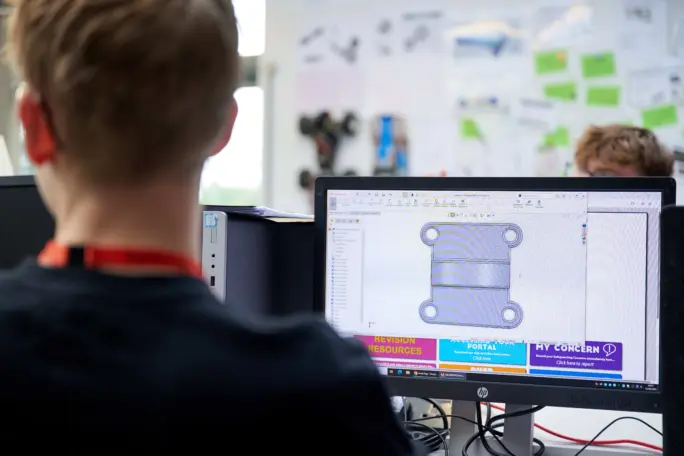
- CAD skills using SOLIDWORKS and Google SketchUp
Students are expected to complete 4½ hours of independent study per week.
Year 2
You’ll complete two coursework units based on industry‑relevant scenarios, applying your learning to real‑world engineering problems and developing solutions using professional approaches.
Skills Developed
- Engineering problem solving
- Application of Maths and Science
- CAD and digital design skills
- Independent and project‑based working
- Communication and teamwork
Teaching includes theory lessons, problem‑solving activities, CAD work and coursework projects. Students engage in structured learning alongside independent study and project work to build understanding and practical skills.
Assessment is through a combination of:
- Two coursework assignments based on real‑world engineering scenarios
- Two external exams testing understanding of engineering principles
Students receive regular feedback through tests, self‑assessment, peer assessment and teacher support to help improve performance.
- Engineering workshop and design studio
- CAD software and digital learning platforms
- Library resources including textbooks and eBooks
- Support from experienced teachers and technicians
Students are required to provide essential equipment and resources to support their studies.
Required equipment includes:
Scientific GCSE calculator (not on a phone)
A4 ring bound folder & 10 tab dividers
A4 lined pad or A4 lined exercise book where pages can be filed in your folder
Pencil Case with:
- Black or dark blue pens
- A green pen for corrections
- Sketching pencil, rubber, sharpener
- 30cm Ruler, protractor, compass
A pair of basic headphones suitable for use with a PC
Students must also have their own copy of the L3 AAQ BTEC National 2025 Engineering Extended Certificate Student Book (approximately £40).
Students are expected to contribute around £10 per year towards materials used in their coursework project and for home access to 3D modelling software.
Having access to a PC at home is strongly recommended to allow installation of CAD software and support coursework outside lessons.
Optional equipment such as a fine liner pen may also be useful depending on individual preference.
The cost of any trips associated with the course is the responsibility of the student.
Financial assistance is available through the student bursary scheme, and students are encouraged to apply as early as possible if support is needed.
Students should not take this course with Product Design / Design Engineering
Students are advised not to choose three coursework‑heavy subjects
Subject combinations should be discussed with staff to ensure they support your future goals.
Engineering AAQ supports progression into:
- Engineering degrees (mechanical, electrical, civil, aerospace)
- Higher and degree apprenticeships
- Careers in engineering and related sectors such as project management
Students have previously progressed to apprenticeships with companies including GKN, Airbus, Babcock, Integral and Rolls‑Royce or onto degree courses such as Automotive Engineering and Architecture.
Students benefit from engagement with industry through visiting speakers and alumni, and are encouraged to make contact with industry experts to support coursework.
Work experience is encouraged to help develop understanding of engineering in real‑world contexts.

Progression opportunities
Related courses

Textile Design
A LevelA Level Textile Design encourages students to develop their individual creativity through practical exploration and design. Working on proje…
Product Design
A LevelProduct Design A Level gives you the opportunity to create, innovate and solve real‑world problems through design. You’ll explore how aesthe…

Design Engineering
A LevelDesign Engineering A Level gives you the opportunity to create, innovate and solve real‑world problems through engineering design. You’ll ex…